


Project Overview
During my internship at AIT (Austrian Institute of Technology) in Vienna, I conducted an in-depth feasibility study for integrating a vision system into WAAM (Wire Arc Additive Manufacturing) industrial machines. WAAM is an advanced manufacturing technique that uses a welding arc to deposit metal wire layer-by-layer, creating large, complex metal parts with minimal material waste.
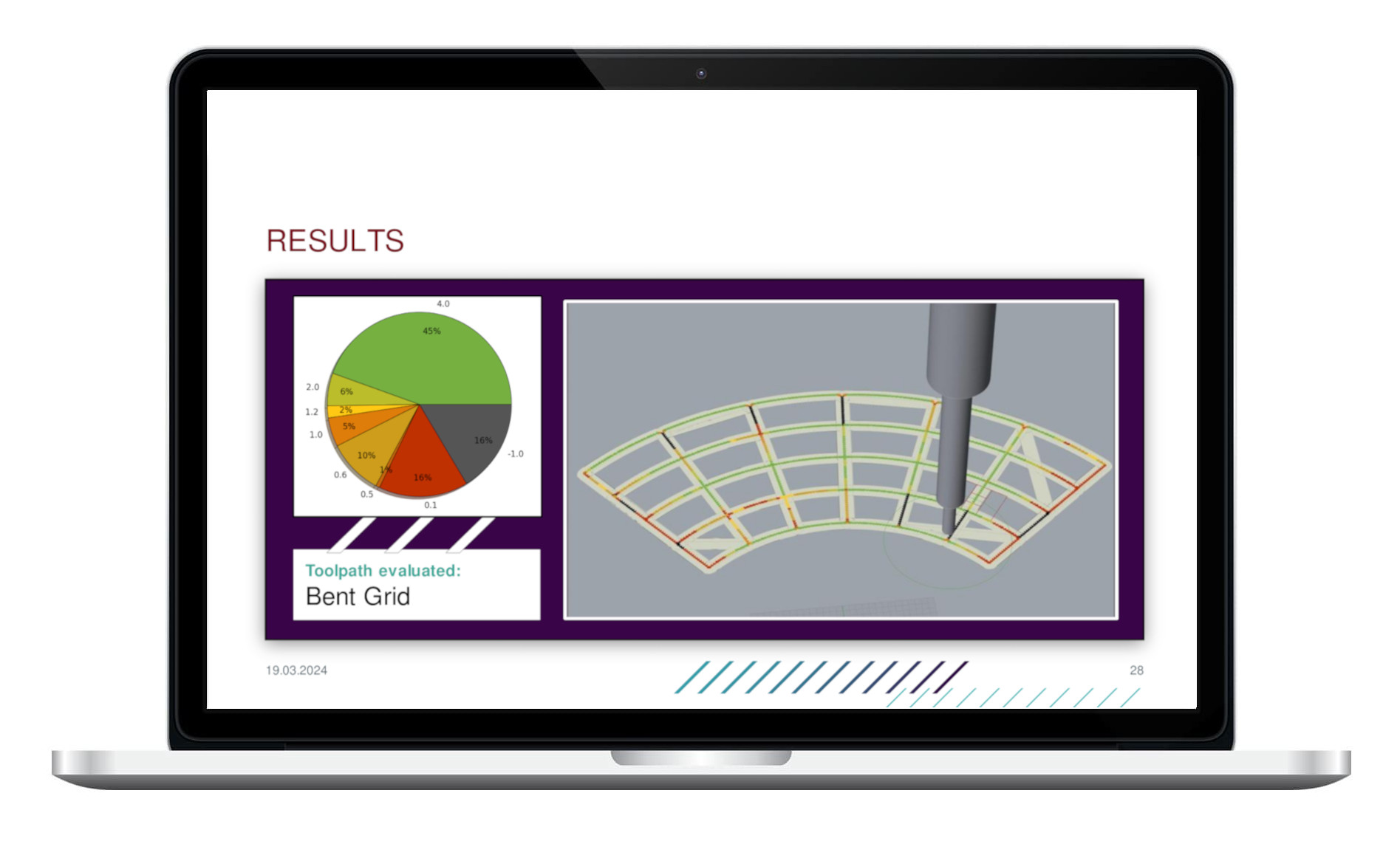
The challenge was to determine whether real-time computer vision could effectively monitor and validate the quality of the additive manufacturing process. The study required analyzing camera capabilities, image processing algorithms, machine integration points, and the feasibility of real-time quality control on a 5-axis industrial machine. And for the biggest part, path following algorithms with several constraints were simulated and evaluated.
Research Scope
The feasibility study encompassed several key areas:
- Path Following: Development of algorithms for camera path following from a fixed distance behind the torch
- Torch Simulation: Simulation of the torch movements and their impact on the camera path
- Image Acquisition: Analysis of camera placement, lighting conditions, and image quality requirements for WAAM monitoring
- G-code Analysis: Investigation of machine commands to correlate vision data with machine states and positions
- Quality Metrics: Definition and measurement of visual quality indicators for additive manufacturing processes
- 3D Modeling Considerations: Analysis of how vision data could inform or validate CAD/CAM models used in manufacturing
Methodology
1. Literature Review & Baseline Research
I conducted comprehensive research on existing vision systems in additive manufacturing,
analyzing published studies on WAAM quality control and computer vision applications in industrial settings.
2. Camera Degrees of Freedom
I evaluated different camera positions and orientations relative to the welding torch. I opted for a configuration
where the camera is mounted on a robotic arm trailing the torch at a fixed distance and with the capability to rotate
the camera on itself, allowing optimal perpendicular orientation.
3. G-code and Machine Command Analysis
I studied the machine's G-code output and control system to understand how to follow the coordinates to
keep the camera in the right place to follow the torch movements at a fixed distance.
4. 3D Model Integration Study
Using Rhinoceros3D, I explored how 2D vision data could be processed to reconstruct 3D part geometry
and validate against original CAD models.
5. Performance & Feasibility Assessment
I benchmarked computational requirements, identified bottlenecks, and evaluated whether real-time processing
was feasible on industrial hardware. The assessment included cost-benefit analysis and implementation roadmap recommendations.
6. Documentation & Recommendations
I compiled findings into a comprehensive feasibility report with technical details, test results,
recommendations, and a proposed implementation path for future development.
Key Technical Challenges Investigated
Arc Light Interference: WAAM processes generate intense arc light that can overwhelm camera sensors and wash out images. For this reason, a Cavitar camera was selected.
Path following noise: The camera path computed was noisy and required filtering to ensure stable tracking of the welding torch, along with smoothing and awareness of sudden direction changes or of jumps.
Geometric Complexity: WAAM produces 3D parts with complex geometries. The more intricate the geometry, the more challenging it is to accurately track the welding torch and keep the seam in the center of the FOV of the camera. So I developed a scoring system to evaluate tracking performance based on these factors.
Tools & Technologies Used
Key Findings
Feasibility Assessment: The study concluded that vision system integration is technically challenging both for the addition of two degrees of freedom to move the camera, and for how hard it is to keep the seam at the center of the FOV for complex geometries.
Improving Factors: To ensure a good quality of the live inspection, some changes were suggested for the camera setup, starting from an auxiliary arm to improve positioning flexibility.
Implementation Path: A phased approach was recommended, starting with offline image analysis before progressing to real-time monitoring, with careful validation at each stage.
Economic Viability: While initial implementation costs were significant, and the potential for improved quality control and reduced scrap rates justified investment in vision system technology for high-value WAAM applications, it was determined that further optimizations in the design of the system were needed to make real-time processing feasible on industrial hardware.
Research Outcomes
The feasibility study produced:
- Comprehensive technical report with detailed findings and recommendations
- Proof-of-concept image processing algorithms for seam detection and analysis
- Performance benchmarks for real-time processing requirements
- Cost-benefit analysis and implementation roadmap
- Documentation of technical challenges and proposed solutions
Impact & Learning
This project deepened my understanding of computer vision applications in industrial manufacturing. It reinforced the importance of systematic research methodologies, the challenges of real-world computer vision deployment, and the need for creative problem-solving when integrating new technologies into established industrial processes.
Working at AIT gave practical insight into how hardware and software work together and the challenges of deploying new technologies in industry.